Abraham's speedo of faith

The way that Kierkegaard tells the story in Fear and Trembling, the biblical Abraham, when faced with doing what God says and sacrificing his son, or doing what morality says and, you know, not sacrificing his son, chooses to do what God says because he is a “knight of faith.”
With apologies to anyone who actually understands Kierkegaard, I have to puzzle through this myself. This is presumably someone who is committed to something that he understands in a personal way that he can't express in terms that would justify it. Commitment to do something wrong isn't that strange, though, and it's also not strange to be committed to doing something wrong that you mistakenly believe is right. Abraham's case is supposed to be different. He isn't simply doing what he wants despite knowing that it's wrong; more interestingly, he also can't believe that it's right. To be right isn't a private judgment: it's an appeal to some standards, if not of ordinary morality, then at least of some moral standards.
Here's an analogy. You can use the word "literally" to mean literally, and the dictionary will back you up that this is an ordinary use, and you can use it to mean figuratively-but-take-me-seriously, and many people will make sense of and defend that usage because that appeals to another set of standards. If you use the word to mean small-adult-horse, though, you're just wrong. No set of shared standards for the word mean that. Words' meanings, like right and wrong more generally, isn't something that you can simply decide on your own.
Kierkegaard's example of Abraham is that Abraham takes Isaac up to Mount Moriah to sacrifice him because he received a divine command. Abraham, on this view, knows that killing his son is morally wrong, but he is also committed to doing what he was commanded to do, and the puzzle is that he both knows that this is wrong and doesn't believe that this is wrong. That's flatly paradoxical, so something more has to be said to explain how this is a puzzle and not simply a contradiction.
To start with, we're not assuming that Abraham is unaware of or insensitive to morality. If morality didn't matter to him, then the story is only about God inconveniencing Abraham, something like asking Abraham to run an errand. (And God called to Abraham, and Abraham responded "Here I am." And God said to Abraham, "Go out, you and your only begotten son Isaac, whom I have given to you, to Mount Moriah, a journey of three days, where you will pick up a few things for me.") It's surely more than that.
Assuming there's a conflict, then, what's the conflict? Only one side seems to be a moral obligation, so is it a conflict between Abraham and morality? Like Crime and Punishment, but where Raskolnikov becomes the founder of a religion?
Maybe the conflict is a conflict between ordinary morality and some "higher" morality. But what is "higher"? Morally higher, meaning that it's morally higher than moral? It's a funny way of saying it, but I can make sense of it: it's moral to give to an art charity but morally "higher" not to murder. But a conflict between morality and "higher" morality is no conflict at all, since there's a clear answer.
If the higher standard isn't morally higher, then what is it? There are other standards, but it's not clear that any of them are higher. Moral standards tell me to have sustainably made clothes; financial standards say I should have quality garments at good prices; sartorial standards dictate that I should have stylish clothes, with an emphasis on look and feel, not on origin or cost. (Gustatory standards say my clothes should have nutritional value?) Which standards are higher than moral, when in conflict?
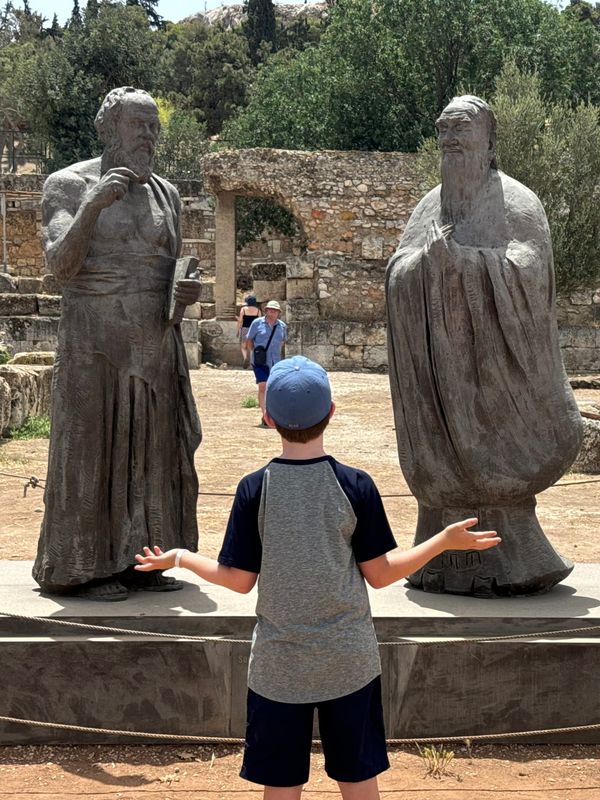
Kierkegaard refers to what Abraham does as the "teleological suspension of the ethical," which--is this what Kierkegaard meant?--I can make sense of as a third option: Abraham's decision is literally unjustifiable by the moral standards of all those around him. It's absurd to insist on one's own private standards as standards, in exactly the way it's absurd to insist that "literally" means small-adult-horse. But what Abraham is doing by his action is placing a bet, so to speak, that his absurd action will be justified, in retrospect, as the first instance of a new standard that will develop in a way that will justify his current action. He's doing the moral equivalent of using "literally" in this absurd way, or of being the first person to wear bell-bottom jeans. Or, maybe to use a more dramatic example, he's going into an important business meeting where everyone is in a suit, and he's not only foregoing a suit and tie, but also shirt and pants, and wearing only a leopard print speedo. And he's doing this not because he's mentally ill or trying to sabotage the meeting, but because he's convinced that, someday, people will see that bold speedos are the new power suit.
It's so tempting to say that the analogy is that speedo-Abraham is convinced that someday people should see bold speedos as the new power suit, but "should" only makes sense within some set of standards. If Abraham thinks that bold speedos should be seen as a new power suit, then he can, in principle, justify them: they're more suitable to a warming climate, they intimidate by showing fearlessness, etc. But if there are norms to appeal to, then it's a conflict of norms, and we're back to the regular case.
In the Euthyphro dilemma, the question is whether morality (or "the pious") is good because the gods command it or the gods command it because it's good. In Abraham's case, he does what he does because "the gods" command it, but that doesn't make it good. "Good" isn't the same as "liked." Something can be liked because one person has a certain kind of private feeling about it. Something can't be good because of one person's private view, though: "good" means good according to some standard. There can be competing standards of what is "good," maybe even irreconcilable standards, but there have to be some standards.
If there's no appeal to any standards, then there's no sense in which Abraham's actions are justifiable. He can be committed to his actions, but whatever justification he offers is a sophisticated version of "I really want to" and not a version of "it's good" or "it's right." If his "I really want to" is very sophisticated, it's more like "I cannot be myself if I don't" or even "I cannot live if I don't," but those are still expressing a commitment, not a justification. I can agree with you that you cannot be yourself or even that life isn't worth continuing if you don't wear your leopard print speedo to the business meeting, but I'm not thereby saying that any standards (moral, financial, sartorial, etc.) would justify it.
So, Abraham's conflict wouldn't be a conflict between moral standards. It's a conflict between present moral standards and a commitment to as-yet-unrealized moral standards. On the one hand, there are recognizable moral standards; on the other hand, there is an action that Abraham trusts will summon its own justification, that Abraham is committed to in part because it appeals to its own yet-to-be-developed standards.
There's nothing yet for Abraham to cite in defense of his action. All he can say to "justify" it is to describe the action in a way that shows that it's intentional, not accidental, and deny that it appeals to some existing standards. It's as if businessman Abraham, when asked about his leopard print speedo, responds with "I was convinced, when I looked in the closet this morning, that this was, without a doubt, what I had to wear today." He can't say, "I had to wear this because I lost a bet" or "I'm pledging a fraternity," which would appeal to standards that are understandable, even if most people would disagree that he would have made the right decision. He can't even say, "this outfit really cools me off," which would be a partial justification, but not enough to justify an action of this magnitude. Similarly with Isaac.
What's interesting to me about the cases is that the bet might or might not pay off, but the reason it pays off can't be because it's already the right thing to do. It's not yet the right thing to do. Before Abraham discovers the particular relationship with God that comes to seem normal, it's wrong to kill your son; afterwards, there's at least a conflict. (Again, it's complicated: there are lots of ways to understand the story of the binding of Isaac.)
So this is the question I'm left with, which is the question that actually motivated me to think this through. It there any sense in which the first person to act on one of these absurd let-the-future-norms-justify me is doing anything right, or whether what they're doing is sacrificing themselves morally knowing that they'll bring about better standards in the future.